Showing posts with label development economics. Show all posts

Thursday, December 17, 2009

Management Lessons

As CCHIPs assessed health centers for expansion, we visited nine of eleven health centers. Our visit to Murandi was eye opening. Murandi has no NGO support and yet it is THE model health center.

As the Titulaire of Murandi tells it, two years ago he sat the staff down and they set a goal: to be the best health center in Musanze District. They organized a PBF committee to implement improvements to get a higher score on the Performance Based Funding (PBF) evaluation. Other committees regularly meet to coordinate other improvements. The staff even decided to forego some of their personal PBF bonuses to use the money to improve the health center.

Essentially, Murandi has a functional management structure. The structure allows it to identify problems and implement improvements.

Zack and Jeanne d’Arc decided it would be a good idea to get the Shingiro staff together with the Murandi staff. We wanted to see if some of the spark at Murandi might rub off on Shingiro.

So on a Thursday afternoon we picked up ten members of the Shingiro staff. We brought key personnel – the Titulaire, the Adjunct Titulaire the Accountant, the Data Manager, the Cashier, the Mutuelle Accountant – all of the key management people that we needed to take more initiative.

The drive to Murandi is gorgeous, driving up and up through the hills.


On the ride, Zack talked a lot about how great it would be for the Shingiro staff to see the Murandi staff at work, “We need to implement improvements at Shingiro based on the Murandi model as quick as possible.”

After introductions, the staffs paired with their counterparts. I followed Marie Josee, the Shingiro Accountant, and Desiree, the Murandi Accountant. Desiree showed Marie Josee how he calculates the daily balance in his computer, how he checks it with the Mutuelle office, and how he manages the work of the Cashier. It was a really impressive system: efficient and accurate. The staff had clearly spent a lot of time and effort thinking about and implementing the best way to do the accounting.

I thought about the importance of the visit: If we could show the Shingiro staff the benefits of how Murandi functions, we might convince them to adopt the same management systems.

Instead of spending months making iterative improvements, we found a model that works now. If Shingiro could implement it quickly, it might save a lot of time: probably the most effective way to turn a weakness into a strength is to identify the strongest performer and copy what they do.

There is a strong counterargument to this position, which advocates fixing a recognized gap in performance by improving slowly in steps that lead to the ultimate goal.

…

I wrote the rough version of the above right after the trip to Murandi, in early October. I didn’t post it or expand on it at the time. I tried. But I felt like there wasn’t enough to say. We didn’t know what the true result of the trip would be. I didn’t know which side of the debate to take: the radical or the iterative approach to developing management systems.

At the time, the choice seemed binary – either the management team could identify areas for improvement and take slow and steady steps toward improvement or it could implement radical improvements based on a successful outside model.

After working with the Shingiro management team for several months, I’ve come to realize that the choice is not binary. The choice is not even particularly important. What is important is the capacity to recognize and implement the appropriate approach depending on the needs of the moment.

Three months after the visit to Murandi, Shingiro does not have the Murandi-type management systems in place: the accounting is still a bit of a mess, there is no PBF review committee, the Pharmacy management isn’t as good as it should be. Zack’s goal to quickly put the Murandi systems in place before the Shingiro staff forgot them could not have been done under the circumstances. At the time of the Murandi visit, Shingiro did not have a management structure that was capable of implementing much of anything.

…

The CCHIPs approach is to work closely with health center staff to help them develop their own solutions to problems. In this way, solutions will be thoroughly understood by those applying them and the staff will feel a sense of ownership and control over how the health center operates.

At the beginning of the project, both Zack and I made the mistake of trying to create ‘tools’ for the health center staff that are extremely user-friendly. For example, Zack developed an Excel accounting workbook. I developed a database for health data – just put the data in here and presto!, all set.

Both of these tools failed. Zack and I assumed that by locking formulas and making it very clear where to input the figures, the Shingiro staff couldn’t mess up our perfect workbooks.

But, of course, they could and they did.

Even more importantly, the Accountant didn’t understand how the income and expenses link together to create and follow a budget and the Data Manager couldn’t interpret the output of the health database. Without the understanding of why the tool was useful, neither tool had much value.

We decided we needed to give the staff a more comprehensive understanding of the logic underlying the tools, so that, if they chose to do so, they could create the tools themselves.

What we realized is that to impart real and lasting change, you need to help a manager develop the capacity to ask ‘why?’ Our managers must have a comprehensive understanding of the systems that they are managing. Without a comprehensive understanding of how processes fit into the wider scope of health center operations, the health center cannot respond to change and its managers cannot recognize areas for improvement.

There are mechanisms out there, like surveys of health centers that help managers to identify areas for improvement at the health center level. These tools can be useful. For example, we were excited to visit Murandi because they do extremely well on the surveys. But the surveys rely on outsiders to identify areas for improvement. Outside standards cannot be as effective as expert managers that are deeply engaged with their own health center operations.

As we continued to work at Shingiro, we came upon a vital insight:

Empowered managers ask questions. These questions lead to an understanding of why things are the way that they are. On the basis of that understanding, managers can proactively develop plans to optimize operations.

At the time of the Murandi visit, there was no structure to facilitate the process of questioning to understanding to action. Shingiro needed a management structure to facilitate the implementation of such a decision.

A strong management team can identify areas for improvement and address them through iterative solutions OR by importing a system from outside. The team can mix and match strategies because they have the capacity to understand problems and develop the right solution.

Murandi showed us that our efforts are possible. Murandi proves, beyond a doubt, that Rwandans can manage themselves, that our efforts are not in vain. Not that we doubted that. But it was powerful for the Shingiro staff to see it.

In response to this problem, Zack has worked very hard to develop and implement a new management structure at Shingiro.

Under the old system, every employee directly reported to the Titulaire. When CCHIPs arrived at Shingiro health center, there were only about 10 nurses. However, as the staff has grown to about 20 nurses, this arrangement has become completely ridiculous.

Additionally, no one was responsible for the management of any particular Specialty. Technically the Titulaire was responsible for ensuring the Pharmacy was fully stocked, that the vaccine cold-chain was maintained, that Wound Dressing had gauze, that HIV/AIDS had retroviral drugs, and so on. In reality, this meant that in some Specialties individual nurses took responsibility and in other Specialties there was chaos. There was no way to ensure that equipment was not missing, that the files were not out of order, and so on.

Inevitably, such as system only had enough capacity to ensure the health center was running OK. The Titulaire would have needed heroic personal strength and no need for sleep to implement and monitor any changes.

So it’s no surprise that the Titulaire is a huge fan of the new management structure.The new structure is not particularly innovative or complex. It doesn’t need to be – it just needs to work. There are two major components of the new system:

  1. There is now a level of management between the Titulaire and each Specialty. Four nurses serve as Service Managers who report to the Titulaire. Each Service Manager is responsible for their Service – Curative, Preventative, Promotional, and Administrative.
  2. Each Specialty has a Specialty Responsible - one nurse accountable for the operation and improvement of each Specialty. The Service Responsibles report to the Service Managers.

During the orientation of the new managers, Damascene, the new Curative Service Manager, said, “Woah, I’m responsible for so many people now – in Reception, Consultation, Wound Dressing, Pharmacy, and the Laboratory.”

To which Felicien, the Titulaire, replied, “Yeah, imagine how I felt directly managing all of those Specialties and all of the others.”

At the Specialty level, the Specialty Responsibles are now motivated to improve their Specialties. The Responsibles know that they have the support of the Service Managers to implement lasting improvements. And when the Service Manager needs feedback from the Specialty level, the Responsibles can provide upward perspective.

This structure gives the Titulaire and Service Managers the time and space needed to set direction. It increases the capacity of the management structure because the Titulaire is no longer solely responsible for identification, implementation, and monitoring.

…

Over the last two months since the new structure was put in place, it has been amazing to see how quickly the health center has begun to do things for itself. The new management system created the institutional capacity to be proactive.

The Titulaire and the Service Managers meet regularly, without CCHIPs’ presence. They have been able to create

  • Based on their experience as nurses, the Service Managers identified the problem of nurses sleeping on night guard duty. The Titulaire, Felicien, and the Curative Service Manager, Damascene, coordinated the staff to relocate the Child Consultation room and use the old Child Consultation room as a Night Guard room. This lets the night guard nurses sleep when there are no patients but they are close to where patients arrive for help.
  • The Service Managers noticed that the hand-washing facilities were insufficient. Based on the system developed at Murandi, Felicien and the Service Managers designed and oversaw the construction of new hand-washing points at Shingiro.
  • I have worked with the new Preventative Services Manager, Aggripine, to improve the filing and patient follow up systems in Preventative Services. We collaborated with her and the Family Planning Specialty Responsible to reorganize the filing system in Family Planning. Now Aggripine will be able to oversee the implementation of similar systems in Antenatal Counseling, Vaccination, and HIV/AIDS.

The new management structure allows the health center to identify problems, to understand why the problems exist, and to develop and implement solutions. Whether those solutions are big changes or small ones, developed at Shingiro or elsewhere, the important thing is that those solutions will be implemented successfully.

Friday, December 4, 2009

Dedicated People Following Their Instincts

Sometimes, in the midst of all the work I’ve been doing with CCHIPs in Rwanda, I lose track of what I’ve learned. It’s easy to lose sight of the big lessons in the day-to-day, but recently I read something that helped crystallize a thought.


I saw a blog post by William Easterly at Aid Watch. Easterly writes about his visit to a maternity and family planning clinic in Ethiopia. After only an afternoon visiting the project, he developed a positive assessment of the program. The post touched on two things that I have found to be true:


1. The key to an effective organization is the dedication of its people


2. For evaluating human resources and management, the value of randomized trials/statistical analyses is often not worth the cost (in time, resources, etc) compared to a quick site visit and the instincts of experts


Since CCHIPs is a small team, I have had the opportunity to work with the Jeanne d’Arc and Zack on management and strategic planning issues. For example, in preparation for CCHIPs’ expansion to 4 additional health centers in 2010, I analyzed the available surveys of health center performance and the health data of patients seen.


We evaluated health centers based on two dimensions: Need and Capacity. The CCHIPs team wants to work with health centers where we can have the biggest Impact – we do not want to be dropped into the worst possible situation and have little means of fixing anything, nor do we want to be dropped into the best health center and have little to fix. We want to identify health centers that have a lot of needs for help, but specifically needs that align with the expertise that we developed at Shingiro. Therefore, for the expansion presentation I wanted to quantify both the NEEDs of the health centers and our CAPACITY to address those needs.


Our capacity to help a given health center varied in three very specific ways:

Distance: A few of the health centers are very far from our project house in Ruhengeri, up to an hour and a half drive each way. If we worked with those health centers, we would use 3 hours each day just travelling to the health centers.


Public Health Centers: Some health centers are run by the Catholic Church. We expect to work with the diocese health centers in the future. But for now the Church’s veto power over potential reforms/changes/initiatives would sap a LOT of our capacity to have an impact.


Rural/Urban: We are developing a model for the delivery of primary healthcare in a rural context. The health center in Ruhengeri was not a good option.


Our capacity also varied in less specific ways. There are intangible management and human resource considerations: ‘Does the Titulaire seem professional and focused on results? How does the management communicate with the staff? How receptive is the management to our help?’ The many potential answers to these questions do not easily fall into a standard ‘check-the-box’ survey.


We visited 9 out of 11 health centers in the District to get a read on these intangibles. We considered developing a standard assessment form across each of the 5 Elements to score needs and our capacity. However, we didn’t have time to develop the standard survey before we had to choose new health centers.


So we conducted site visits and had meetings afterward to talk about what we saw.
The process wasn’t scientific. We didn’t have a standard assessment form. We didn’t even have a standard ‘de-briefing’ form. We had no definitive statistical ‘proof’ that our choices for expansion were correct.


Even so, I am 100% confident that we chose the right health centers.


I know we chose the right health centers because I know our team. We are focused. We are dedicated to our mission. We know what kind of challenges we are capable of handling.


The capacity assessments came from our guts. Our gut instincts were right because we have dedicated ourselves to understanding what we do well.


We share a mission and we are all guided by the same set of values. Because we are experts on ourselves, we can assess our capacity to create an impact accurately without the need for a standardized form. We can go to a health center, look around a bit, and get a feeling: We know whether the Titulaire wants to work hard. We can tell whether the staff is attentive to the patients. We recognize problems that we have seen before – and we know how to fix those problems.


Only a dedicated, motivated team thinks in this way. A dedicated, motivated team sees problems in the right way. A dedicated, motivated team knows how the pieces fit together. A dedicated, motivated team pulls the right levers to achieve results.
And a dedicated, motivated team can see its own values in the actions of others – we are looking for the same dedication and motivation in the health center staffs that we work with.


Maybe that focus is not there at the beginning. At no health center we saw was it fully formed or functioning. Shingiro’s getting there, bit by bit. But with a couple health centers, you saw where the shift might start. Saw small good habits already in place, a Titulaire’s unconscious consciousness.


A statistical study or analysis cannot see how everything fits together in the same way experts can. A standardized survey can’t see that spark.


This has be a big shift in perspective for me – looking for that spark. Looking for that dedication. It’s been a vital thing to learn. I remember starting work last year and trying to develop the ‘perfect analysis’ to every problem. Now it seems like such a silly goal. It’s like in econometrics: as you add more variables to a regression your model will ‘explain more’. But that model may not tell you much about what’s actually going on.


The reason you do statistical analyses is to look at things in isolation and to present challenges to your assumptions. There’s no proof in data. It can only push you towards or away from the ‘common sense’ beliefs you hold.


The more expert a team becomes, the more the ‘common sense’ thoughts will be correct.


And the only way for a team to become experts is through motivation and dedication.


I love doing statistical analyses. It is really fun to clearly show a relationship or a trend through data. But I have learned, and now I really understand, how data only carries the explanatory power of the frame you put around it.


The current perception in the District is that Shingiro is doing amazingly well. Most District officials would probably guess that Shingiro is performing much stronger on all the surveys and health data than it actually is.* Yes, Shingiro is improving across the standard surveys and in the health data but the gains are not enough to justify the highly positive assumptions in the District leadership.

However, the District’s perceptions are not wrong.


There have been fundamental improvements at Shingiro. The new management structure is far more coherent and capable. The infrastructure investments will continue to attract greater use by the community. The nutrition program is identifying and treating many children. Medical trainings and protocols are improving the quality of care. The staff feels empowered to make decisions and take the initiative to get things done. The health center is more engaged with the community and community members are beginning to use the health center more often. In short, Shingiro is a different health center than it was a year ago.


So Shingiro’s scores on the surveys and health data do not tell the story of improvement that is taking place at Shingiro. Not yet, though the improvements will no doubt be manifested in the data over time. But even then the data will never be able to tell the story of Shingiro or measure the intangible spark that’s been animated here. To see that spark, you have to drive up the bumpy clay road and take a look around.


*Shingiro ranked #1 on one key survey for the third quarter. But Shingiro still is only ranked third to fifth on the other major survey. Meanwhile, the actual usage rates as reflected by the health data are as much a function of the community’s attitudes and incomes as the quality of care provided at the health center. The health data is improving, and faster than the District as a whole, but off of a much lower base.

Sunday, November 8, 2009

Rubindi Umuganda

Over the last two months, Mutuelle sensitizations have been scheduled and rescheduled a half dozen times. We made it through 4 of the 6 cells in Shingiro’s catchment area before the local elections. Many of the cell coordinators were not reelected (I don’t have any read on whether they did not run or were replaced by voters) and we had to wait for the new cell coordinators to settle in before we could approach them to let us speak to their communities.


At any rate, this past weekend we were able to speak with the good people of Rubindi. It was quite a Saturday morning.


The last Saturday morning of every month is Umuganda. Because taxes are hard to extract from low income communities, the government instead asks people to volunteer labor. It’s not a bad system, though ideally it would be unnecessary.


So at 9 AM on a Saturday morning, Elie, Consolate and I piled into the Land Cruiser, bright eyed and bushy tailed. We picked up Laurent, the Mutuelle Accountant and interim Manager, on the way.


Rubindi is in a really nice area, flatter than most of the rest of Shingiro’s catchment area, with lush, green fields during this, the rainy, season.


We rolled up the road into Rubindi and took the left fork to what I think of as its main town. When we arrived, Elie wandered off to find out where the Umuganda/sensitization was going to be while Consolate and I tried to interact with the community members. A woman sitting on a blanket was shucking ears of corn while about 12 children (probably not all her own) stood around her, a couple of them half-heartedly helping.


An old woman came up to me. She was smoking a pipe, and was leaning on a walking staff. “Matamuetze,” she said, and then all I heard was something about “Faranga.”


Elie came back, “It is in another place,” he said.


We left and the woman had to be restrained from trying to the Land Cruiser with her cane. “Awww,” said Consolate, “Some people just feel entitled to get money because they are old.”


We drove back to the fork in the road, and this time took the right fork. We drove a bit to what looked to be a school, where we found several people coming up from a path that led down into the valley below.


“They said that the Umuganda is across the valley, down at the new school that is being built,” said Elie, “You can ride with me while I drive around, or walk.”

I turned to Consolate, “Let’s walk.”


It was such a beautiful morning and within 15 seconds walking on the trail I know I had made the right choice.


The path was covered in fist-sized pebbles, neither small enough to crunch through or big enough to support our steps. So we slip-slided our way down the trail – even though I was wearing my hiking boots, I probably turned each ankle 2-3 times.


Consolate and I quickly lost sight of Laurent, who was moving speedily down the path. The view continued to be amazing.


There was a river at the base of the valley.


We crossed the stone bridge over the stream and arrived at the school where the Umuganda was taking place. There were several hundred people gathered in total, with community leaders talking to them in groups of 50-100 each.


“They are deciding who will be on the indigent list,” said Consolate. This is very important business, because indigents receive financial aid for Mutuelle, among perks. However, there is no really good ways to decide who is and is not an indigent – how do you compare wealth in a largely non-cash economy? Thus, a lot of people get on the list, many more than are given financial aid. We have found this to be a big problem for Mutuelle, because the final indigent lists are not announced until January or February – after the Mutuelle enrollment period closes. After the Mutuelle period closes (December 31), new enrollment activations are delayed by a month. The delay is to prevent people from waiting until they get sick to enroll. However, many people who are on the indigent list wait to see if they will get sponsored, and if they are not sponsored but want to enroll they then have to wait 30 days for coverage.


Elie had not yet arrived in the Land Cruiser. Consolate called him, “He says that the Land Cruiser is stuck in the mud,” she said. Laurent collected a group of 10-15 guys and they ran off to help push Elie out of the mud.


At previous Mutuelle sensitizations, we had attracted maybe 75-150 people. But because this was at an Umuganda, there were probably 300-400 people present. At this point, though, 400 sets of eyes fixed on my every movement doesn’t feel much different than 100.


As the minutes passed, I noticed small groups of people leaving. The Umuganda had concluded, so now people were just waiting to be lectured by us. I decided that I needed to do something to keep them interested in us and what we were going to say.
I turned to Consolate, “We have to dance.”


“What?” she asked.


“We have to do something really embarrassing, to make everyone think ‘what are those crazy Muzungus doing? I better stay to see if they do something interesting.’ C’mon, it’ll be fun.”


Consolate sort of giggled and refused to help.


So I did a little groove.


The idea, of course, worked perfectly. Every single person in attendance started looking at me and laughing and pointing. This was pretty fun for a couple of seconds.


Fortunately for my fragile dancing-ego, a few seconds later Elie pulled up with Gertie.


With no delay, the three to four hundred people circled around. Elie and Laurent spoke for a while - everyone seemed interested and listening but it’s hard to get a read on the crowd when you have no idea what’s being said.


After Elie and Laurent spoke, they opened the session up to questions. The head of COSA, the local quasi-governmental organization that technically runs the health center, got up and asked a question.


“What did he say?” I asked Consolate.


“He asked whether CCHIPs would help pay for extra indigents,” she replied.


I was struck by the extreme inappropriateness of the forum for the question. And it kind of pissed me off. I stewed – what kind of question is that? You can’t sand bag us like that in the middle of a presentation. Elie began to give an answer, though he appeared to be equivocating. I thought about the question, and what could be the right answer. I thought I had something worthwhile to say, and I went over to Elie and asked if I might say something. I began in English…


“I came to Rwanda two months ago from America. I have not been here long, but I’ve seen the beauty of this country and the potential of its people. Based on everything I’ve seen and the people I’ve meet, I can see that Rwanda is a great country. And I believe it will soon be a wealthy country. But this wealth will not be given to Rwanda. Received wealth cannot last. You must work hard to create it. CCHIPs is a tiny part of the growth and change that will come to Rwanda. Focusing on health centers, we are here to help Rwanda fulfill its great potential. I have seen progress made every day and I know that great things can be done. But we do not give hand outs. We can give ideas and training. With those ideas and that training, Rwanda can grow and support its own indigents. That’s what CCHIPs does because that’s the best use of our limited resources. We could cover everyone’s Mutuelle for a year, but it’s better for us to help Rwanda grow so that it can support itself forever.”


Elie said, in Kinyarwanda, “I’m sure you all understood what he said…” That got a good laugh from everyone. Then Elie began to translate what I had said…


…As Elie entered into his fifth minute of translating my thirty second speech, I turned to Consolate, “what is he saying?”


“You know Elie, he loves to go on and on. Right now he is saying how what you said is like how you treat a child. You support them less and less as they grow up.”
“Wait, what? No! That’s very colonialist. I did NOT say that.”


“It’s ok, they won’t care.”


But I care, I thought,OK, the analogy is not totally false, but it’s also not very PC. I kept thinking about it as Elie finished speaking. We thanked everyone for having us, and got back in the Land Cruiser.


As we drove out of Rubindi, we had to stop several times for people to move their mats covered in sorghum. It had become a sunny day and the people were taking the opportunity to dry out the harvest before selling it.


The whole ride home, I thought about what exactly I meant, about why CCHIPs is in Rwanda, about why I’m in Rwanda, about what forms international aid and NGO interventions should take. Not small topics, I guess.


At the very least, I concluded a few things, which I plan to touch more on in this blog:


1. In Rwanda, critical thinking and forward planning are missing skills sets. This is not to say that Rwandans are stupid or can’t make decisions, but there are socially constructed and learned ways of viewing the world that improve economic decision-making. These skills are far from ubiquitous.


2. I strongly believe that if those deficits in critical thinking and forward planning were erased, Rwanda would grow at a high rate for a long time.


3. For those with an entrepreneurial frame of mind, there are so many opportunities to make money here. Indeed, I’ve met several entrepreneurs here who I plan to write more about.

Thursday, September 24, 2009

Mutuelle


Shortly after I arrived, Elie and Consolate brought me up-to-speed on their efforts on Mutuelle (community insurance). It’s one of my big projects here and it consists of three goals:


  1. Boost Mutuelle enrollment in the Shingiro catchment area for 2010
  2. Develop a report for the District Mayor on common barriers to enrollment and recommendations to overcome those barriers.
  3. Liaise with the Shingiro Mutuelle office as part of the broader effort to make Shingiro a better health center


Mutuelle enrollment costs RWF 1,000 per household member for each year. The Mutuelle-subscription year corresponds to the calendar year. To prevent people from only purchasing Mutuelle when they become sick, aka to prevent adverse selection, Mutuelle must be purchased before the year begins. If families wait until the subscription year to purchase Mutuelle, they face a 30-day waiting period before their Mutuelle enrollment becomes active and can only purchase for the current year until June. Mutuelle enrollment for the next year begins in August. Thus, from now until the end of December is the important period for enrolling community members. An additional measure against adverse selection, heads of household must purchase Mutuelle for every member of their households, not just those that are mostly likely to become sick.


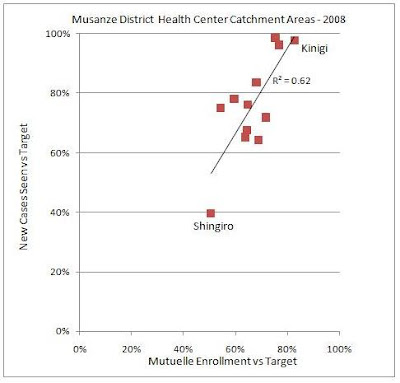
Mutuelle enrollment is the key to creating access to the formal health system in Rwanda. Indeed, looking at the data from 2008 in the Musanze district, there is a strong correlation between Mutuelle enrollment and health center use at the 11 health centers:


*I should note, in loyalty, fairness, and kudos to CCHIPS, that “Mutuelle Enrollment vs. Target” and “New Cases Seen vs. Target” in Shingiro are both up considerably in 2009 - no doubt helped by CCHIPS involvement.


While correlation does not prove causality there are a few points of reality that make the distinction moot:

  • Mutuelle is a great deal for its members. The true cost of health care is far higher than the RWF 1,000 enrollment fee, which is ‘only’ about $2. Mutuelle is subsidized by various NGOs and the government. Thus, beyond the normal insurance functions of consumption smoothing, risk pooling and so on, Mutuelle gives preferential access to the health center vs out of pocket payers.
  • We do see enrollment creep up between January and June, as people recognize that they need Mutuelle after they get sick. However, this just reinforces the argument for educating people about the cost-savings of using Mutuelle before they get sick. Mutuelle creates access to health centers at an affordable price.
  • The subsidization means that adverse selection is less of a problem, in the short run at least. Very few families have a risk profile for illness that makes not purchasing Mutuelle a good bet.


Therefore, I suspect that the Mutuelle enrollment rate indicates the proportion of the population that a. believes in the formal healthcare system vs traditional healers or doing nothing at all and b. is able to pay for coverage.


Focusing on Mutuelle enrollment allows the health center to ‘bag’ wins and concentrate its ‘sales’ effort within a relatively small window of time. We don’t have to expend significant resources all year round trying to one-off convince people on the benefits of using the health center. We know how many people will use the health center based on our enrollment figure, and we know the time period that we need to focus on to sell health center use for the whole next year.


A question raised by the subsidization of Mutuelle is: ‘if you are already heavily subsidizing the system, why not just give free healthcare to everyone? Why make people pay anything at all, if that will get them to use health services more often?’


There are a few reasons:

  • The poorest (“indigents” in local parlance) receive financial aid to cover the Mutuelle enrollment fee (though we are looking at the current system of identifying these people – it does not work very well).
  • Forcing people to pay for at least part of the cost of care helps prevent adverse incentives from forming (such as creating a sense of entitlement, etc). It might also create good habits and general acceptance of health insurance as ‘just something you do’.
  • NGO pockets are deep, but not limitless. In fact, we are currently doing analyses of what would happen to the Shingiro budget if various sources of income were delayed or ceased (my working hypothesis: if Mutuelle cut back on its reimbursements, the health centers would quickly become insolvent).
  • Most important is the recognition that the current system is developing alongside the Rwandan economy. The goal is for most parts of the healthcare system to not fundamentally change when the system becomes self-sustaining. It is important to sensitize (a favorite word of Rwandan technocrats) the population to the benefits of using the health centers, even if they cannot afford them currently. Indeed, using the health centers now might help people be able to afford them in the future. The hope is for the development of a virtuous cycle with better health standards driving income growth driving a greater ability and willingness to pay for health services.


Despite these qualifications, it is clear that Mutuelle is not an ideal system for paying for care. However, it’s hard to imagine an ideal system, given the willingness to pay for most people is lower than the cost of providing healthcare. But we’re not here to create an ideal system. We are working at a local level; we are not trying to redesign the Rwandan healthcare system or how the government should ask its citizens to pay for that system. We are trying to help the health center staff maximize the quality and usage of the health center in a way that is implementable, replicable, and can be easily monitored. Mutuelle is clearly important to this effort.

Wednesday, September 23, 2009

Nyarabuye and Development Economics

This post is a first of a handful oriented towards development economics that I hope to publish over the next few months. There is a world of difference between the theories in the Ivory and Ivy Towers and the world around me. Whereas academics are clean, the world is messy. But both are interesting…


We had a much stronger turnout for the Mutuelle meeting at Narabuye than at Mudende. We did our schpiel, and then Elie translated for me as a local official explained several government policies.

Two policies in particular piqued my interest...


Umudugudu

Under the Umudugdu (Village) policy, rural citizens will be given a 20m by 25m plot of land within a village to construct a house. These villagers will relocate from their homes which are scattered across the countryside.

A lonely house far from neighbors.

Homes in the fields.

Currently, these villagers live near their fields, but clumping will (hopefully) allow human and health services to be more easily delivered. These services include:

· Rural electrification

· Sanitation and indoor plumbing

· Communications infrastructure

· Local trade and commerce

· Closer access to health facilities

By moving closer together, individuals lower the marginal cost of all of these services/transactions. Additionally, to mitigate the switching costs, the government is giving advanced warning, including recommending that people do not invest in permanent homes until the villages are laid out. This policy has not yet been enacted and surveyors continue to plot the ideal locations for villages and homesteads within villages.

Though on the whole I think it is a sound idea , there are a handful of potential drawbacks to the policy:

  • This policy will increase the monitoring costs for residents. Currently, it is easy to make sure no one steals your crops – you look outside. Now people will have to monitor their crops in some other way. Perhaps it will give rise to security services – this could be an important value add for a crop insurance program.
  • It is unclear who will bear the switching/moving costs
  • People here are really poor. If they have a good thing going where they live now, it sucks to force them to move.


Crop Specialization

The speaker next spoke about a crop policy the government is enacting. Going forward, people will only be allowed to grow particular types of crops in different regions. For example, some regions may grow maize while others potatoes and others wheat. The speaker told the people that at some point the government would be inspecting fields and tearing out plants that are not allowed to be grown in the region.

This drew a loud outburst from the assembled villagers. They did not seem to love this policy. My initial reaction was first-world, freedom-loving indignation. People should be able to grow whatever they want! But then I thought about it a bit:

Positives:

1. Encourages specialization

a. Hopefully, farmers will more efficiently grow one or two crops instead of 5 or 6.

b. This specialization should generate a net surplus of food, which will encourage trade and employment opportunities outside of farming

2. Encourages trade

a. People will sell the one type of surplus crops that they grow for cash and purchase a basket of other types of crops and goods and services.

3. Encourages the use of currency

a. Currently, one of the issues we face with Mutuelle (community health insurance) is that people use bartering instead of cash, and therefore have no way to pay for enrollment.

b. Trade will necessitate the use of money

Negatives

1. Ignores individual preferences / abilities

a. Hopefully government agronomists designated districts best suited for growing maize as maize districts and so on

b. Even so, there will be certain farmers that are currently better at growing some crops over others and areas of land within regions that are better suited for different types of crops than is designated based on region-wide characteristics. This will lead to sub-optimal use of land. (Though that is not to say that the land is currently being used more optimally.)

2. Will interfere with market function

a. Related to the first point, in a perfect system, market demand, field characteristics, and farmer abilities would determine the most profitable crops to grow in a particular field.

3. Several residents noted that they do not currently grow the crops designated for their region. Thus, they faced switching costs such as 1) learning how to grow the new crops and 2) buying the initial inputs such as seeds or crop-specific tools

4. Our nutrition program emphasizes, among other things, a balanced diet. While in theory it is great for farmers to specialize and trade, the policy might encourage “diet specialization”.

5. Crop diversification may help hedge risk. Farmers might plant different crops that are resistant to different disasters, like drought-resistance crops, pest resistant crops, etc. With specialization, a whole region can be wiped out by a particular crop disaster (think Ireland in 1848).

The policy will not be enforced for some time period, so people will have time to adjust. At its core, the crop policy assumes that the government will make better choices than local farmers. Given the low penetration of education among the rural poor, I’m not convinced that this is untrue.

Generally, it seems hard to know whether it makes sense to wait for an endogenous impetus to push such a large change or use the force of law to induce an exogenous shock. There will likely be a number of unforeseen consequences of both these policies, but the long term benefit may outweigh the short to medium term pain.

Over a long time horizon, the hope is that these policies together will encourage better access to human services, economic specialization, the development of a rural service sector, and, generally, economic development. These policies take a step in the right direction. However, in the short run the policies are likely to 1. provoke widespread non-compliance from the population and 2. create unintended and unforeseen complications for everyone involved. The successful implementation of these policies will depend on the government’s flexibility in reacting to these issues and strong monitoring and enforcement mechanisms.

I’ll keep watching, talking, and listening to people.